




A Step-by-Step Guide: How to Introduce Cats to Each Other Successfully
Bringing a new cat into your home can be exciting, but learning how to introduce cats to each other requires patience, planning, and a gradual approach. Whether you are bringing home a kitten, adopting an adult cat, or helping two cats adjust to sharing a home, rushing the process can create unnecessary stress and conflict.
Every cat has a different personality and comfort level. Some cats may adjust within a few weeks, while others need several months. The goal is not necessarily to make the cats become best friends, but to help them feel safe and learn to coexist peacefully.
Understanding Feline Behavior Before You Introduce Cats
Cats are territorial animals, and many prefer predictable surroundings and familiar routines. A resident cat may see a newcomer as an unfamiliar presence in its established territory. This can lead to hissing, hiding, avoidance, growling, or other signs of stress.
At the same time, cats can form strong social bonds with other cats. Their response to a new companion depends on factors such as personality, age, previous experiences, socialization, and their environment.
Each cat’s health and overall well-being also matter during a major household change. Understanding the factors that can influence your cat’s lifespan can help you provide consistent care throughout different stages of your cat’s life.
The most important rule is simple: let the cats’ behavior determine the pace instead of following a strict timetable.
Prepare Your Home Before Introducing the Cats

Good preparation can make the introduction much easier. Before the new cat arrives, create separate areas and make sure both cats have access to essential resources.
Create a Safe Room for the New Cat
Choose a quiet room that can be completely separated from the resident cat. This will become the new cat’s safe space during the early stages of the introduction.
The room should contain:
- A litter box
- Food and water bowls
- A comfortable bed
- Safe hiding places
- A scratching post
- Age-appropriate toys
- An elevated resting area if possible
Keeping the new cat in a separate room allows it to become comfortable with the new environment without immediately facing another unfamiliar animal.
Give Each Cat Separate Resources
Resource competition can increase tension between cats. Provide separate food and water stations, resting areas, scratching posts, and litter boxes.
A useful general guideline is to provide one litter box per cat, plus one extra, and place them in different areas of the home. Multiple resources give cats more opportunities to avoid competition and choose where they feel comfortable.
Do not expect the cats to share everything immediately. Peaceful coexistence is more important than forcing them to share the same resources.
Helpful Supplies for a Cat Introduction
A few simple supplies can make the process easier:
- Feline Pheromone Diffuser – May help create a calmer environment during periods of household stress.
- High-Value Cat Treats – Useful for creating positive associations during scent and visual introductions.
- Interactive Wand Toy – Helpful for supervised play and redirecting attention during calm interactions.
- Baby gate or screen barrier – Allows controlled visual contact without direct physical interaction.
Amazon Product: Feline Pheromone Diffuser
The Step-by-Step Process for Introducing Cats

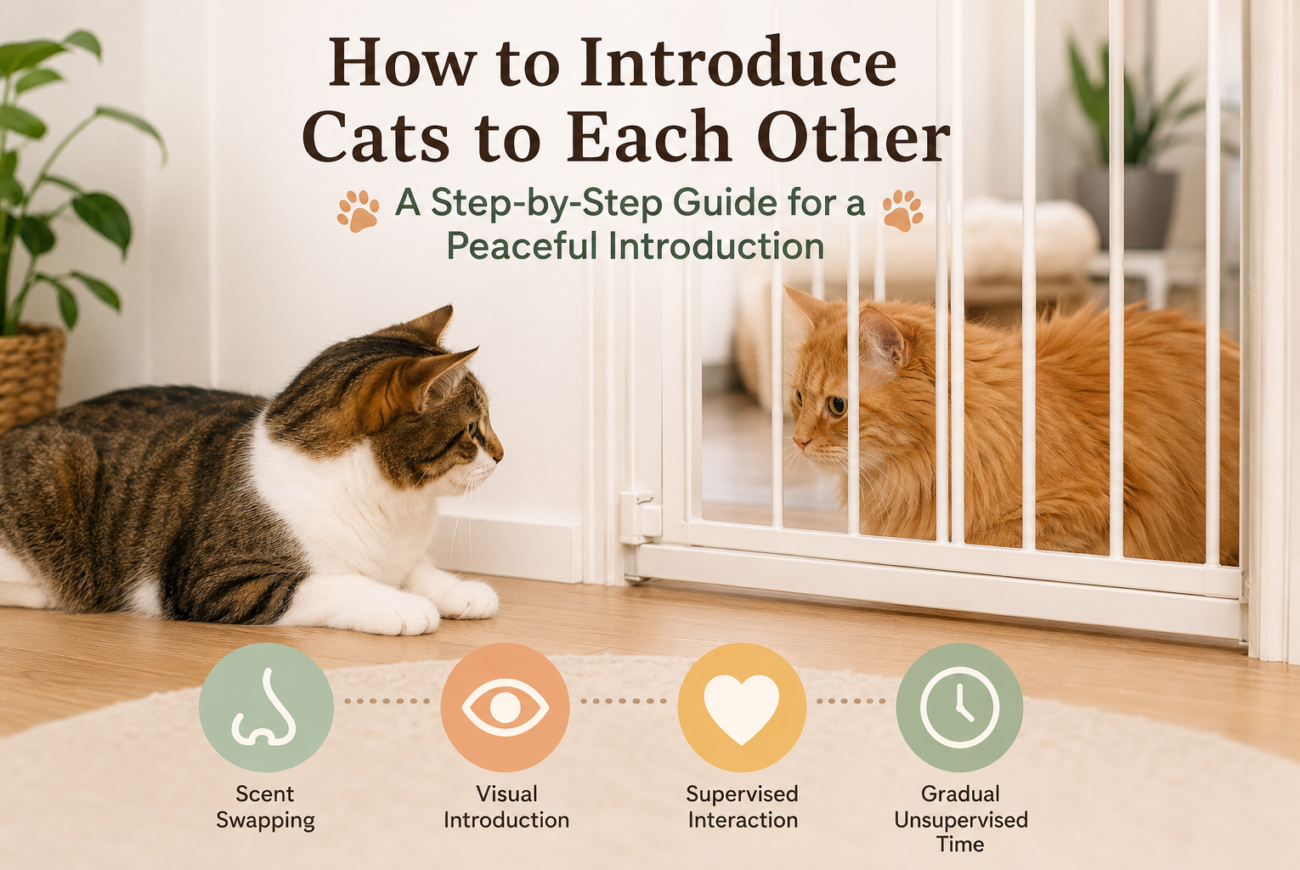
A gradual approach is an important part of learning how to introduce cats to each other without creating unnecessary stress.
A gradual introduction usually works better than placing two unfamiliar cats together immediately.
| Phase | Key Activities | Goal |
|---|---|---|
| 1. Scent Swapping | Exchange bedding and introduce scents | Familiarize cats with each other’s scent |
| 2. Visual Introduction | Allow controlled visual contact through a barrier | Build positive associations |
| 3. Supervised Interaction | Allow short, supervised meetings | Build comfort and trust |
| 4. Gradual Unsupervised Time | Slowly increase time together | Encourage peaceful coexistence |
The cats may move through these phases at different speeds. If either cat becomes highly stressed, return to the previous stage and progress more slowly.
Phase 1: Scent Swapping and Familiarization
Start by allowing the cats to learn about each other through scent without direct contact.
Exchange bedding, blankets, or soft toys between their areas. You can also gently rub a clean cloth around one cat’s cheeks and place it near the other cat’s living space.
Another useful technique is feeding the cats on opposite sides of a closed door. Start with the bowls far enough away that both cats remain relaxed. Over time, gradually move the bowls closer to the door if both cats remain comfortable.
The purpose is to help each cat associate the other cat’s scent with something positive, such as food or treats.
This gradual scent-based approach is an important step in how to introduce cats to each other successfully.
You can also use High-Value Cat Treats during these sessions to create a positive association. Keep the portions small and offer them only when both cats remain calm.
Amazon Product: High-Value Cat Treats
Do not rush this stage. If a cat repeatedly hisses, growls, refuses food, or becomes visibly distressed, give the cat more space and continue scent work for longer.
Phase 2: Controlled Visual Introductions
Once both cats are comfortable with each other’s scent, begin brief visual introductions.
Use a baby gate, screen door, or another secure barrier that prevents direct contact. Allow the cats to see each other from a comfortable distance while offering treats or meals.
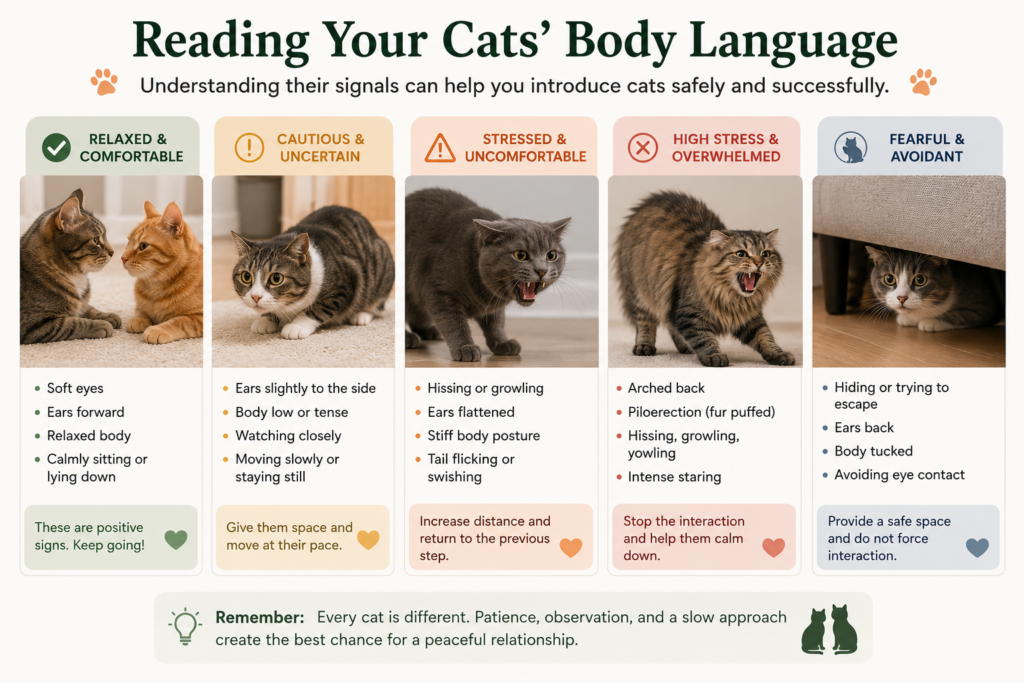
Keep the first sessions short. Watch their body language carefully.
Signs that a cat may be uncomfortable include:
- Hissing or growling
- Flattened or rotated-back ears
- Stiff body posture
- Persistent staring
- Trying to hide or escape
- Swatting at the barrier
- Refusing food
If either cat becomes tense, calmly end the session and try again later. Do not punish hissing or other warning signals. Instead, increase the distance or return to scent swapping.
As the cats become more relaxed, gradually increase the length of visual sessions.
Phase 3: Supervised Interactions and Playtime
When visual introductions are consistently calm, you can begin short face-to-face meetings.
Choose a space where neither cat feels trapped. Make sure there are escape routes and places where a cat can move away if needed.
Keep the first interactions brief and closely supervised. You can use an Interactive Wand Toy to create positive experiences and redirect attention when needed.
Allow the cats to decide how close they want to get.
Some cats may sniff each other and walk away. Others may simply observe one another from a distance. These can both be positive steps.
Do not force the cats to sit together, share food, or play together.
If tension increases, calmly separate the cats and return to an earlier stage of the introduction process.
Amazon Product: Interactive Wand Toy
Phase 4: Gradually Increase Unsupervised Time
Do not immediately leave two newly introduced cats alone together.
First, make sure they can spend supervised time together without persistent aggression, chasing, blocking, or intense fear. When their interactions remain consistently calm, allow very short periods together while you are nearby.
Gradually increase the amount of time they spend together.
Even after progress, continue providing separate resources and safe spaces. Cats may need the ability to retreat from one another at any time.
Only allow longer periods without supervision when both cats have demonstrated that they can peacefully share the home.
Common Challenges When Introducing Cats
Knowing how to respond to stress, fear, and tension is an important part of how to introduce cats to each other safely.
Even with careful preparation, cats may experience setbacks. The key is to recognize stress signals early and slow down when necessary.
Hissing, Growling, or Tension
Hissing and growling are communication signals that often indicate discomfort or fear. They should not automatically be treated as signs that the introduction has failed.
If these behaviors occur repeatedly, increase the distance between the cats and return to an earlier stage.
Never punish a cat for hissing or growling. Punishment can increase fear and make the introduction more difficult.
If the cats begin fighting, do not try to handle an agitated cat with your hands. Separate them safely and give them time to calm down.
Never allow cats to “fight it out.” Repeated fighting can make the conflict worse rather than resolving it. For additional guidance, see the ASPCA’s advice on aggression between cats.
If aggression continues despite a careful reintroduction, speak with a veterinarian or qualified feline behavior professional.
Fear, Hiding, or Avoidance
Some cats may hide when they are introduced to a new environment or another cat. This can be a normal stress response.
Never drag a hiding cat out of its safe space.
Instead, provide comfortable hiding areas, elevated resting places, food, water, and a litter box nearby. Allow the cat to come out at its own pace.
A fearful cat may need several weeks or longer before becoming comfortable. Patience is more effective than forcing interaction.
Resource Guarding
A cat may become protective of food, litter boxes, resting spots, or favorite areas.
To reduce competition, provide multiple resources in different locations. This gives each cat the ability to move away instead of being forced to compete.
If one cat repeatedly blocks another cat from accessing food, water, litter boxes, or resting areas, slow down the introduction and increase resource separation.
Sudden Behavioral Changes
A sudden change in behavior should not always be assumed to be caused by the introduction.
Stress can affect behavior, but medical problems can also contribute to unusual behavior or aggression. If a cat suddenly stops eating, develops unusual symptoms, or shows a significant change in behavior, contact a veterinarian.
Signs of a Successful Cat Introduction
Success does not necessarily mean that your cats become inseparable friends.
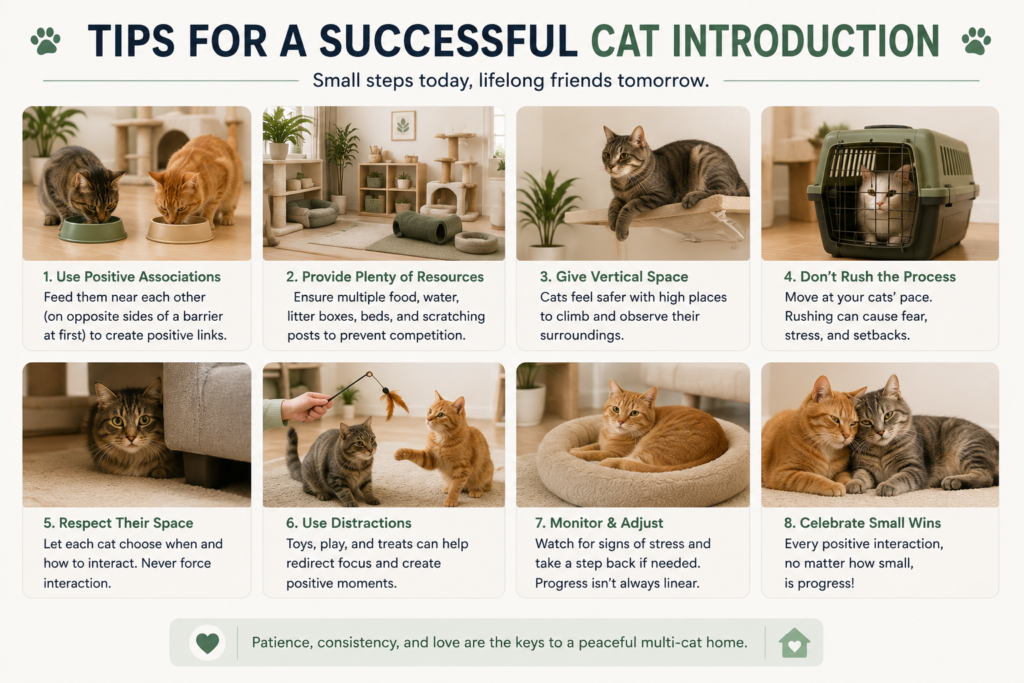
A successful introduction means both cats can feel secure and move around the home without persistent fear or conflict.
Positive signs may include:
- Relaxed body language around each other
- Calmly passing one another
- Eating without persistent tension
- Resting in the same room at a comfortable distance
- Playing independently while sharing the same space
- Choosing to approach each other voluntarily
- Grooming themselves normally around each other
- No persistent chasing or blocking
- Normal use of food, water, and litter resources
Mutual grooming or sleeping close together can be positive signs, but they are not required for a successful relationship.
The real goal is peaceful coexistence, not forced friendship.
Frequently Asked Questions About Introducing Cats
How long does it take to introduce cats to each other?
There is no universal timeline. Some cats adjust within a few weeks, while others may need several months.
The introduction should progress according to the cats’ behavior. If either cat becomes consistently stressed or aggressive, slow down and return to an earlier stage.
Can I introduce an adult cat to a kitten?
Yes. Adult cats can live successfully with kittens, but their different energy levels can sometimes create challenges.
Give the adult cat places to escape and rest away from the kitten. Supervise their interactions and provide the kitten with appropriate play opportunities so the adult cat does not have to constantly manage the kitten’s energy.
Age alone does not guarantee compatibility. Personality and individual temperament also matter.
Should I let my cats eat together?
Not necessarily.
During the early stages, feeding cats separately can reduce competition and help them feel secure. You can gradually bring their feeding areas closer if both cats remain relaxed.
There is no need to make cats share the same bowl.
What should I do if one cat keeps hissing at the other?
Hissing is a signal that the cat is uncomfortable. Increase the distance between the cats and return to an earlier stage, such as scent swapping or feeding on opposite sides of a closed door.
Avoid punishment and do not force the cats to remain close together.
What if my cats never get along?
Some cats may never become close companions. The goal should be a safe and low-stress household rather than forcing a friendship.
If persistent aggression continues despite a slow and structured introduction, speak with your veterinarian or a qualified feline behavior professional. In some cases, permanent separation within the home may be necessary to protect both cats’ well-being.
Conclusion: Patience Is Key When Introducing Cats
Understanding how to introduce cats to each other can help you create a calmer and more comfortable environment for both cats. Learning how to introduce cats to each other successfully requires patience, preparation, and careful observation.
Start with separate spaces, introduce scents before allowing visual contact, and gradually progress to supervised interactions. Provide enough food, water, litter boxes, resting areas, and hiding places so neither cat feels forced to compete.
Most importantly, let the cats determine the pace. A slow introduction may take more time, but it can give both cats a better opportunity to feel secure in their shared home.
With consistency and patience, many cats can learn to coexist peacefully, even if they never become best friends.
