




Fascinating Facts About Cats: Biology, Behavior, and History
The Biology of Felines: Key Facts About Cats’ Anatomy and Senses
The domestic cat (Felis catus) possesses a suite of biological adaptations that underscore its success as a species. Many fundamental facts about cats relate directly to their physical makeup, which is finely tuned for hunting and agility. Isko short aur natural kar do:
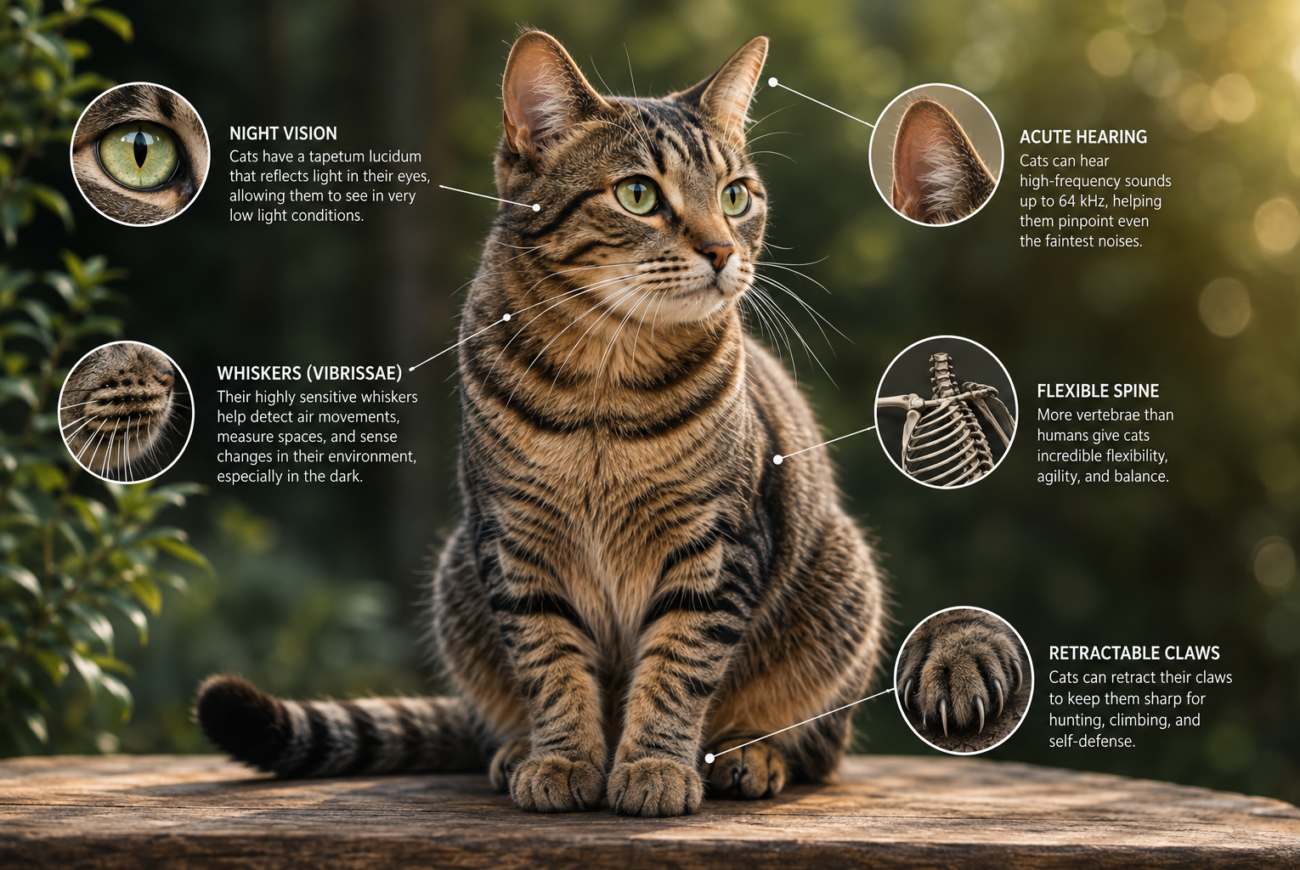
Their bones and muscles support flexibility and speed. Their sensory organs also help them stay highly aware of their surroundings.
Remarkable Sensory Abilities
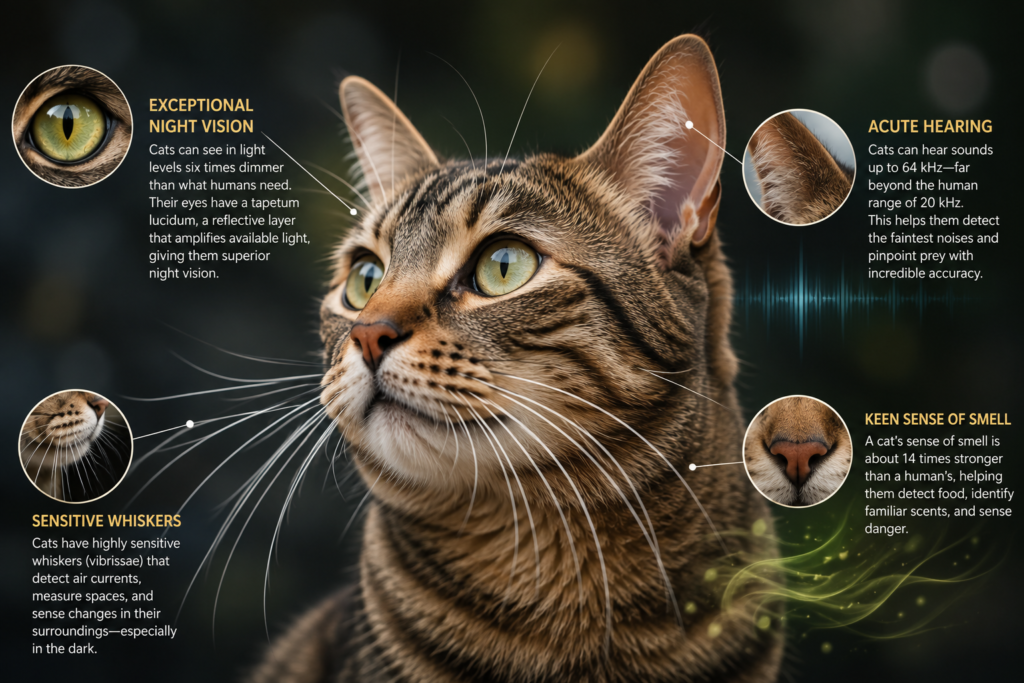
Cats exhibit extraordinary sensory capabilities.Cats have excellent night vision. Their eyes can work well in much lower light levels than human eyes. This ability comes from many rod cells in the retina and a reflective layer called the tapetum lucidum. Cats also have exceptional hearing. They can detect frequencies up to about 64 kHz, well above the human hearing range. This enables them to pinpoint the exact location of prey, even faint rustling sounds. Perhaps most iconic are their whiskers (vibrissae), which are deeply rooted in nerve-rich tissue. These sensitive hairs help cats navigate their surroundings. They detect air currents and help cats judge narrow openings. Whiskers also provide useful information about nearby objects, especially in darkness.
These combined cat senses are vital for their survival.
Unique Physical Traits
A cat’s physical structure is a marvel of evolutionary design. Cats have a highly flexible spine with more vertebrae than humans. This structure supports their agility and helps them twist their bodies in mid-air. It also allows them to squeeze through tight spaces. Cats have retractable claws that they can sheathe when not in use. This helps keep their claws sharp for climbing and grasping. Their specialized teeth include sharp canines for piercing and carnassial teeth for shearing meat. Together, these features support their role as efficient carnivores.These aspects of cat anatomy are central to their success.
Behavioral Insights: Understanding Cat Habits and Communication

Understanding the behavioral facts about cats provides clarity on their often-misunderstood actions. Their habits are deeply rooted in their ancestral predatory instincts, even in the most domesticated settings. While often perceived as solitary, cats exhibit complex social dynamics and employ a diverse range of communication methods.
Hunting Instincts and Play
Even well-fed house cats retain a strong predatory drive. This innate instinct manifests in their play behaviors. Chasing toys, pouncing, and stalking are not merely games; they are simulations of hunting. This cat play is crucial for their physical and mental well-being, allowing them to exercise their natural predatory instincts. Providing opportunities for simulated cat hunting helps prevent boredom and can reduce unwanted behaviors, as it fulfills a fundamental biological need.
Decoding Cat Communication
Cats communicate through a rich repertoire of signals. Cats use many cat vocalizations to communicate with humans. These include meows, purrs, hisses, growls, and trills. Each sound can convey a different message.
Beyond sounds, cat body language offers profound insights. The position of their tail, the orientation of their ears, the dilation of their pupils, and even the direction of their whiskers all convey specific messages about their mood, intentions, and comfort level. Cats also use scent marking to establish territory and communicate with other felines. They may mark through rubbing, scratching, or urine spraying. These behaviors are not always noticed by humans.
Historical and Cultural Significance of Cats
The journey of cats from wild animals to cherished household companions is a compelling narrative, revealing many historical facts about cats. Their relationship with humans spans thousands of years, shaping cultures and mythologies across the globe.
Domestication Journey
Humans likely began domesticating cats about 9,500 years ago in the Fertile Crescent. This process developed alongside the growth of early agricultural settlements. Early farmers struggled with rodents that ate their stored grain. Wild cats (Felis silvestris lybica) naturally came to these areas because they offered an abundant food source. This symbiotic relationship, where cats controlled pests and humans provided an indirect food supply, led to a gradual process of cohabitation and eventual domestication. Evidence of ancient cats buried alongside humans in Cyprus supports this timeline. From this origin, domestic cats spread globally, often accompanying human migrations and trade routes.
Cats in Mythology and Society
Throughout history, cats have held diverse and often contradictory roles in human societies. In ancient Egypt, cats were revered, associated with deities like Bastet, and protected by law. Killing a cat, even accidentally, could result in severe punishment. Conversely, people in medieval Europe often associated cats, especially black cats, with witchcraft and superstition. These beliefs sometimes led to the persecution of cats.. In Japanese folklore, the Maneki-neko (beckoning cat) is a common symbol of good luck and prosperity. These varied portrayals highlight the deep cultural impact and the many fascinating facts about cats that have shaped human perception over millennia.
Surprising Facts About Cats’ Abilities

Beyond their well-known traits, several lesser-known facts about cats reveal their extraordinary capabilities and unique characteristics. These insights often challenge common assumptions about feline behavior and physiology.
The Mystery of the Purr
A cat’s gentle purr is often associated with contentment.Haan, is baar natural transitions rakhte hain taake unnecessary highlighting na ho. Isko poora replace kar do:
Cats may purr for several reasons. They may purr when they feel relaxed, stressed, or uncomfortable.. Research suggests that purring may have soothing effects. These vibrations range from about 25 to 150 Hertz. However, more research is needed to understand their possible effects on the body. The mechanics of cat purring involve rapid movements of the laryngeal muscles. These movements allow cats to produce a continuous sound while breathing in and out.
Agility and Balance
A cat’s remarkable agility and balance are legendary. Their flexible spine, powerful leg muscles, and keen sense of equilibrium contribute to their ability to navigate complex environments with ease.One of the most fascinating unique cat traits is the righting reflex. This natural ability helps cats orient their bodies during a fall. As a result, they can often land on their feet when they have enough time to adjust their position.
This reflex develops around 3-4 weeks of age and is fully functional by 6-7 weeks. Combined with their powerful hind legs, which enable impressive jumps up to six times their height, these features make cats incredibly adept at climbing and escaping danger.
Frequently Asked Questions About Cats
Many common inquiries revolve around the intriguing facts about cats. Here are answers to some frequently asked questions.
Do cats always land on their feet?
Isko is version se replace kar do. Sentences short hain aur transitions bhi natural hain:
Cats have an impressive righting reflex that helps them orient themselves during a fall. However, this reflex does not guarantee a safe landing. Several factors can affect how well it works. These include the fall height, the cat’s age, and its health. For example, a short fall may not give the cat enough time to adjust its position. In addition, falls from greater heights can still cause injuries, even when a cat lands on its feet. Therefore, owners should not assume that the righting reflex prevents injuries.
Why do cats purr?
Cats purr for a variety of reasons, not just happiness. While a contented cat will purr, they also purr when stressed, injured, or giving birth. The vibrations from purring are believed to have self-soothing and healing properties, promoting bone density and tissue repair. Purring is a complex vocalization with several functions. For example, if your cat also experiences vomiting, learn about the common causes and warning signs to watch for.
How many hours a day do cats sleep?
Cats are renowned for their extensive sleep patterns. Adult cats usually sleep for 12 to 16 hours a day. Some cats may sleep for up to 20 hours. This behavior is linked to their predatory nature. Cats conserve energy for short bursts of activity. Even house cats may direct these bursts toward toys instead of prey.
Conclusion
The world of felines is rich with fascinating facts about cats, from their finely tuned biology and complex behaviors to their enduring historical and cultural impact. In addition, their remarkable sensory abilities, unique physical traits, and intricate communication methods paint a picture of a highly adapted and intelligent creature. As a result, understanding these aspects allows for a deeper connection and appreciation for our feline companions. Ultimately, as we continue to share our lives with them, the endless charm and mystery of cats ensure they remain a source of wonder and affection.
